FDA Synthetic Dye Phase-Out: Product Exposure in the Index
How many indexed US food products contain each of the six synthetic dyes the FDA asked industry to drop, and what that request actually requires.
Published:
Research question
How widely are the six synthetic dyes named in the FDA phase-out actually used across the products we index, and how far have the food companies that make those products gone in committing to remove them?
Methodology
In January 2025 the FDA revoked the authorization for FD&C Red No. 3 in food, effective January 15, 2027. In April 2025 it separately asked industry to stop using six remaining certified petroleum-based colors, Red 40, Yellow 5, Yellow 6, Blue 1, Blue 2, and Green 3, — a voluntary request, not a binding rule. Reported target dates for it differ between sources: CSPI records the April 2025 announcement as end of 2026, while the FDA's own pledge-tracking page works toward the end of 2027. We report both rather than pick one. California moved first at the state level with the 2023 Food Safety Act (AB 418) and then the School Food Safety Act (AB 2316), which bans those same six dyes in K-12 public schools from December 31, 2027; that state deadline, not the federal request, is the binding one for those six. PlainFoodSafe tracks each dye in the flagged_ingredients table, which records the additive name, the restriction date with its jurisdiction, and a product-presence count computed by cross-referencing Open Food Facts ingredient lists. A corporate-pledge table used to sit alongside it; it was withdrawn on 2026-07-31 as unverifiable (see below).
Every figure on this page is queried at render time. Product-presence counts use the canonical join between an additive and the distinct products that list it, so a dye that appears under several ingredient-label spellings is still counted once per product. Because Open Food Facts is a contributor-built catalogue skewed toward popular packaged goods, the absolute counts are best read as a relative measure of how prevalent each dye is, not as a census of total US consumer exposure. See our methodology page for the full pipeline and the FDA dye-ban guide for the regulatory timeline in plain language.
Indexed products containing each phased-out synthetic dye
Live from the database, the six dyes named in the FDA phase-out
One dye dominates the shelf
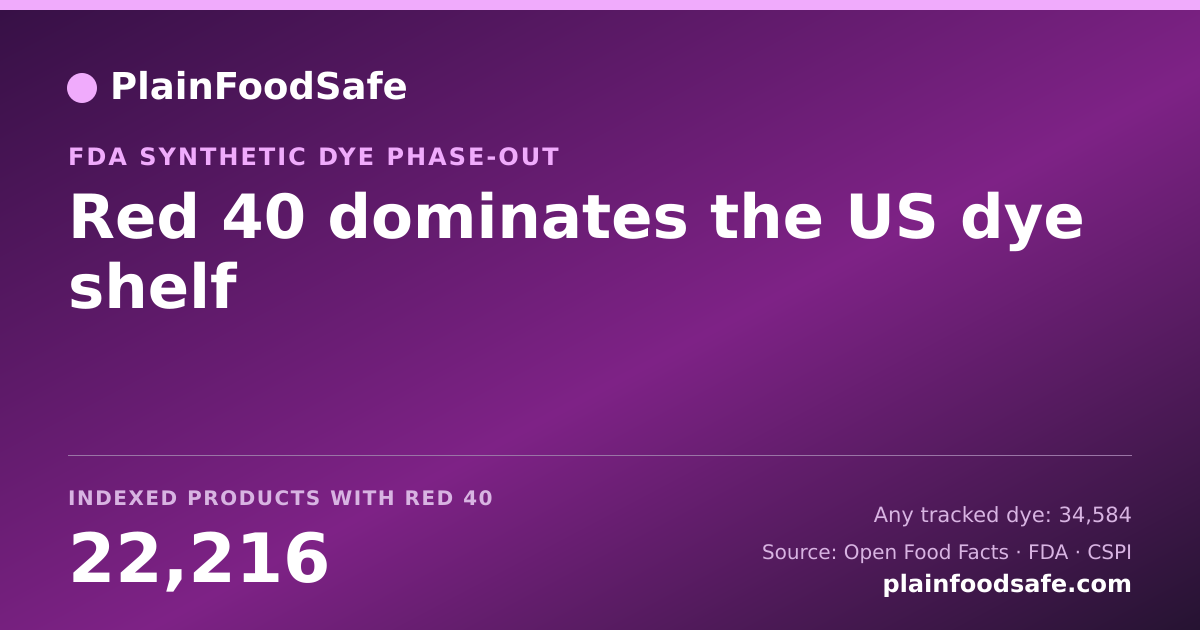
Across the seven dyes charted above, Red 40 is by far the most widely used, appearing in 22,216 indexed products. Taken together, 34,584 distinct products in our catalogue contain at least one of the seven dyes charted here: the six the FDA asked industry to phase out, plus Red 3, which the FDA revoked outright on its own earlier deadline. That is a count of products, not of product-dye pairs: a candy coloured with Red 40, Yellow 5 and Blue 1 is one product, so adding the per-dye bars above would count it three times and overstate the shelf by more than double. Even at the true figure, synthetic colour is not a fringe ingredient confined to novelty candy but a default formulation choice across drinks, cereals, snacks, baked goods, and condiments. The steep drop from the top of the ranking to the bottom also matters for the phase-out: Green 3 and Blue 2 sit in only a few thousand products each, so removing them is a far smaller reformulation task than removing Red 40, which touches an order of magnitude more of the shelf.
That asymmetry shapes how the transition will actually unfold. Manufacturers can drop the rarely-used colours quickly and quietly, but Red 40, Yellow 5, and Yellow 6 are embedded in flagship products where any change to colour risks consumer pushback. The technical substitutes, beet juice, turmeric, spirulina, paprika and other plant extracts, already exist and are used in the European formulations of many of the same brands, where synthetic dyes require a warning label. The barrier in the US has been commercial inertia rather than feasibility, which is why the regulatory deadlines, and whether companies actually meet the commitments the FDA and CSPI track, are the levers that move the timeline.
How far the companies have committed
Corporate commitments are not measured here. We publish only what our own index can show: which dyes appear on which products, and how many. Who has promised what, and by when, is tracked by the FDA and by CSPI, and we link to both rather than restate them.
Why the corporate-pledge table is gone
This section previously listed per-company pledge and target dates. On July 31, 2026 we withdrew it: the dates could not be traced to a source, and at least one row conflicted with the independent record, listing a Mars commitment where CSPI's tracker shows no plan. Corporate commitments are tracked directly by the FDA and by CSPI; we would rather send you there than restate figures we cannot show our working for. The product-exposure counts above remain our own measurement and are unaffected.
What to watch next
The gap between a pledge and a reformulated product is where this story will be decided. A commitment dated 2025 with a 2027 target tells a shopper nothing about what is on the shelf today, which is why product-level tracking matters alongside the corporate announcements. As reformulated lines reach stores, the product-presence counts in the first chart should begin to fall, and because those counts are recomputed on every page load from the live catalogue, this page will register the decline as it happens rather than restating a static claim.
For shoppers who want to act before the deadline, the practical move is the same one the broader processing data points to: the dyes cluster in ultra-processed products, so reading the ingredient list and favouring foods coloured by recognisable plant sources avoids them today. Our dye phase-out tracker follows the commitments as they update, the Red 40 and Yellow 5 profiles show each colour's regulatory status and where it appears, and our companion analysis on the ultra-processed share of US packaged foods puts the dyes in the wider context of industrial food formulation.
Source: FDA color additive actions and public corporate dye-removal commitments; product-presence counts from Open Food Facts ingredient lists. Figures reflect the most recently published dataset.
Embed this on your site
Free to republish under CC BY 4.0. The image is generated from our live index, so it stays current after you paste it. Please keep the link.
Sources
- U.S. Food and Drug Administration, color additive actions - fda.gov
- California OEHHA / AB 418 Food Safety Act - oehha.ca.gov
- Open Food Facts, public product ingredient database (CC0) - world.openfoodfacts.org