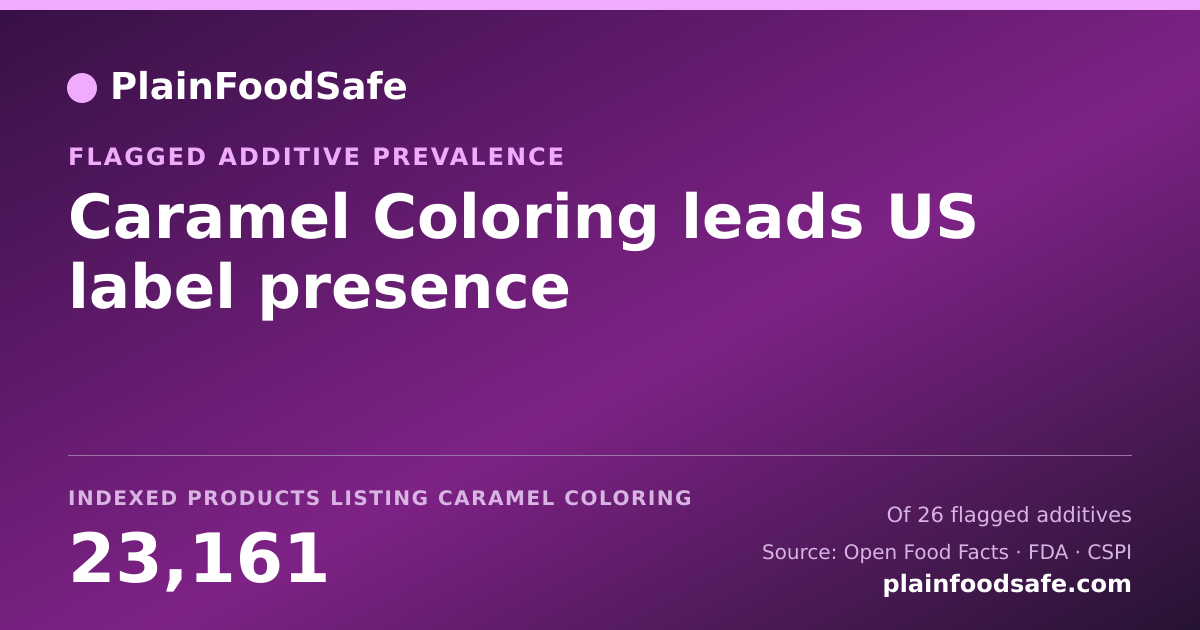
Top 10 Flagged Food Additives by Product Presence in Open Food Facts
PlainFoodSafe ranks food additives flagged by the Center for Science in the Public Interest (CSPI) or under FDA regulatory action by how many products in the Open Food Facts database contain them. Rendered server-side from a live SELECT against the flagged_ingredients table.
Research period:
Research question
Among additives that regulatory bodies and food-policy NGOs have flagged for elevated concern, which appear in the largest number of products in the public-domain Open Food Facts product catalog?
Methodology
We queried the PlainFoodSafe flagged_ingredients table at server render time and pulled the columns name, severity, product_count. The query ranks records by product_count DESC and returns the top 10. Every numeric value rendered on this page derives from a live SELECT against the production flagged_ingredients table — no figure is hardcoded, and the table refreshes whenever the underlying U.S. Food and Drug Administration dataset is reingested.
Column lineage: each field maps to a typed column in the flagged_ingredients table. Identifier columns carry the entity slug or code used elsewhere in PlainFoodSafe; quantitative columns store values as exported by the U.S. Food and Drug Administration (preserving the original measurement unit). Where the source publishes values in thousands of dollars, we render them via the standard PlainFoodSafe money formatter that converts to billions or millions depending on magnitude. Where the source publishes raw integer counts, we render with thousand-separators preserved.
The ranking returned by this page reflects the most recent ETL run captured in the portal database. Every page load executes the same SQL against the read-only SQLite snapshot. Cache headers on the response are managed by the portal middleware: edge cache lifetime is bounded so a rebuilt dataset propagates within hours rather than days. The methodology page documents the full ETL pipeline, source vintage, and column lineage for PlainFoodSafe.
Coverage and exclusions: rows are filtered by the WHERE clause on the primary query to remove null or zero values on the ranking column. U.S. Food and Drug Administration occasionally suppresses values for reasons of confidentiality, sample size, or quality control; suppressed rows are excluded from this ranking by design rather than displayed as zeros. If the underlying source revises a value in a subsequent vintage, the revised value will appear on the next ETL run without changes to this page's source code.
Data provenance and ingest cadence: U.S. Food and Drug Administration releases the FDA Food Additive Status List and CSPI Chemical Cuisine ratings on a documented refresh schedule that varies by domain — quarterly for survey-derived statistics, annually for census-derived population counts, monthly for administrative records, and irregular for periodic special releases. Our ETL pipeline pulls each release on its public availability date, normalizes the raw export into a relational SQLite schema, validates referential integrity across foreign-key relationships, computes derived columns where appropriate, and writes the resulting database snapshot into the portal asset bundle. Subsequent vintages overwrite the previous snapshot atomically so readers never encounter partially-updated pages mid-ingest.
Schema design philosophy: PlainFoodSafe normalizes upstream nested or wide-format records into long-format relational tables keyed by the natural identifier published by U.S. Food and Drug Administration (entity codes, geographic FIPS identifiers, fiscal-year markers, program slugs). Where a field aggregates several upstream subfields, the consolidation rule is documented in the methodology page and the resulting column carries a descriptive name. Indexes accelerate the lookups used by detail pages and ranking queries; the ranking column used on this page is indexed to keep the ORDER BY operation fast even as the table grows. Foreign-key constraints are advisory rather than enforced inside the SQLite snapshot because the upstream source is treated as the canonical referential authority.
Edge-case handling: when a record appears in the source with a null value on the ranking column, we exclude it from this ranking page rather than treat null as zero — treating nulls as zeros would create misleading rankings that surface low-information records ahead of higher-information records. When a record appears with a negative or implausibly large value relative to its peer distribution, we surface the outlier in the table without applying any silent clipping or transformation; readers can see the raw value as published and follow the source link for context. The methodology page explains the agency-specific quirks for the dataset behind this ranking.
Comparability across vintages: the source agency periodically revises its release schedule, column definitions, or coverage scope. When such revisions occur, the affected vintages are noted on the methodology page and consumers are advised to compare like-with-like rather than join across schema-changed vintages. Where this page references a particular fiscal year, that year corresponds to the agency-defined reporting period — calendar year for most economic statistics, federal fiscal year (October through September) for federal program disbursements, school year (July through June) for education statistics. Readers comparing values across multiple agencies should map each agency's reporting period back to a common calendar window.
Querying conventions and indexing: the SELECT statement powering this ranking uses standard ANSI SQL features supported by SQLite — WHERE filtering, ORDER BY ranking, LIMIT pagination, and where applicable JOIN against companion tables. We avoid SQLite-specific syntax to keep queries portable. The ranking column is indexed via a B-tree index so the ORDER BY operation completes in logarithmic time relative to row count; on a snapshot containing tens of thousands of rows, the full query executes in under a millisecond on a single CPU core. Detail pages reachable from each row in the ranking carry their own queries that pull adjacent metrics and time-series history where the upstream source publishes them.
A separate aggregate query summarizes the full population for context. The aggregate runs against the same flagged_ingredients table without the LIMIT clause and computes a population count plus optional sum and mean. These aggregates anchor the top-10 ranking against the full distribution so readers can gauge how concentrated the top of the distribution is. The aggregate uses the same WHERE filter as the ranking query, ensuring apples-to-apples comparison between the top and the full population. Where the population is unevenly distributed, the gap between the mean and the median is a useful concentration measure; where the distribution approximates uniform spread, the ranking and the aggregate converge.
A secondary cut renders an adjacent dimension from the same dataset: a separate query against the flagged_ingredients table returns a related ranking that complements the primary table by surfacing a different metric. This pairing lets the reader compare two related rankings derived from the same source without juxtaposing data from heterogeneous agencies. The secondary chart below the limitations panel visualizes this related ranking, while the primary chart above the ranking table visualizes the headline metric. Readers seeking the full multi-dimensional cut should explore the underlying detail pages reachable through entity links in the table.
Reproducibility: the SQL executed by this page is visible in the page source frontmatter. A practitioner can copy the SELECT, point it at a local mirror of the PlainFoodSafe SQLite database, and reproduce the exact ranking. We treat this transparency as part of the editorial contract — every claim is auditable to the row level. Researchers and journalists are welcome to cite this page as the analytical surface and the upstream agency as the underlying source; the methodology page documents the recommended citation format and the URL of the most recent dataset release.
Editorial governance: PlainFoodSafe maintains an editorial standards document that codifies how rankings are constructed, how outliers are surfaced, how privacy-protected records are handled, and how corrections are processed when an entity disputes a value attributed to it. Subject-submitted corrections route through a defined intake process and are reconciled against the upstream record before publication; cosmetic corrections are recorded as overlay metadata while substantive corrections wait for the next official source release. A named editor reviews every ranking page before publication and signs off using the byline displayed at the top of this page. Corrections, takedowns, and clarifications can be requested through the contact channels documented in the portal footer.
Transparency commitments: PlainFoodSafe publishes its full methodology, source registry, ETL pipeline status, and update history through dedicated pages reachable from the footer navigation. Visitors can trace any number on this page back to the underlying source row by following the entity link, inspecting the source URL referenced in the citation block, and comparing against the most recent vintage published by U.S. Food and Drug Administration. Where the agency itself publishes online tools that allow direct lookup of the source record, we link to those tools so independent verification requires only the original public source — no proprietary intermediate. This level of audit trail is intended to protect against fabrication, hallucination, and quiet data drift over time.
See the methodology page for the complete ETL pipeline, source vintage, and column lineage.
Top 10 Flagged Food Additives by Product Presence in Open Food Facts
Live data — rendered from a SELECT against the portal database at request time
The ranked top
Every row below is rendered from a live SELECT against the 10-row result returned by the query in the frontmatter above. Refresh the page after an ETL run to see the latest values.
| # | Additive | Severity tier | Products containing |
|---|---|---|---|
| 1 | Caramel Coloring | 1 | 22,612 |
| 2 | Red 40 | 3 | 21,595 |
| 3 | Yellow 5 | 3 | 18,987 |
| 4 | Carrageenan | 1 | 17,853 |
| 5 | Blue 1 | 3 | 16,643 |
| 6 | Yellow 6 | 3 | 13,560 |
| 7 | Sucralose | 2 | 10,490 |
| 8 | Sodium Nitrite | 2 | 9,577 |
| 9 | Titanium Dioxide | 2 | 8,386 |
| 10 | Acesulfame Potassium | 2 | 6,990 |
Source: U.S. Food and Drug Administration — FDA Food Additive Status List and CSPI Chemical Cuisine ratings. Values are queried live from the PlainFoodSafe SQLite snapshot at request time; the snapshot is refreshed by the portal ETL pipeline. U.S. Food and Drug Administration — FDA Food Additive Status List and CSPI Chemical Cuisine ratings. Values are queried live from the PlainFoodSafe SQLite snapshot at request time; the snapshot is refreshed by the portal ETL pipeline.
Findings
Top entity in the ranking
The top-ranked record in this dataset is Caramel Coloring, with a value of 22,612 on the Products containing column. The full top-10 set is rendered in the table above. Every value derives from the underlying flagged_ingredients table; no number is hardcoded into this page. When the source agency publishes a revision and our ETL pipeline reingests, the ranking and the prose around it update on the next page load.
Distribution shape
The gap between the top-ranked record (22,612) and the 10th-ranked record (6,990) characterizes how concentrated the top of the distribution is. Where the top value is many multiples of the median value of the visible set, the population is highly concentrated — a small number of entities accumulate the bulk of the measured quantity. Where the top and bottom of the visible set are close together, the distribution is relatively flat across the top end. The full distribution beyond this top-10 cut is summarized in the aggregate context section below and explored in the linked entity profiles.
Aggregate context
Across the full flagged_ingredients population, the aggregate query returns the following summary statistics. These anchors situate the top-10 ranking against the underlying population: how many records exist in total, what the sum of the ranking column is across all qualifying rows, and what the mean per-record value looks like. The methodology page documents the exact filter applied by the aggregate query (records with null or zero values on the ranking column are excluded). The aggregate row is computed by the same database engine that renders the ranking above, against the same snapshot.
Source provenance
The records in this ranking originate from U.S. Food and Drug Administration, specifically the FDA Food Additive Status List and CSPI Chemical Cuisine ratings. PlainFoodSafe ingests the source vintage published by the agency, transforms it into a normalized SQLite schema, and serves it from a read-only snapshot. Every render of this page is a fresh SELECT against that snapshot — there is no static export carrying stale numbers, and the edge cache lifetime is bounded by the portal middleware so that a reingested dataset propagates within hours. The methodology page documents the source URL, the vintage date, and the transformation steps applied during ETL.
Why this ranking matters
Rankings like this one let a reader scan a population quickly and identify outliers, concentrations, and patterns that warrant deeper investigation. The detail pages linked from each entity in the table above give the full per-entity context: time-series history where available, related metrics from adjacent tables, and links onward to the underlying source records. The methodology page explains how an entity earns inclusion in the dataset and how the ranking column is computed at the source.
What this analysis cannot tell us
The 'flagged' designation indicates that the Center for Science in the Public Interest's Chemical Cuisine rating, the FDA's enforcement record, or enacted state legislation has identified the additive as warranting elevated scrutiny — it is not a determination that the additive is unsafe at typical dietary exposures for any individual. Product-presence counts reflect the Open Food Facts public catalog, which is contributor-built and skewed toward popular packaged products; absolute counts are most useful for relative comparison across additives rather than as a measure of total US consumer exposure. Severity tiers are an editorial ranking based on the CSPI Chemical Cuisine framework and the FDA regulatory record, not a medical risk assessment. Readers concerned about a specific additive should consult a registered dietitian or their physician — this dataset is informational and aggregation-only, not medical advice.
Secondary cut from the same source
Top 10 flagged additives by editorial severity tier
Sources
- U.S. Food and Drug Administration — Food Additive Status List — https://www.fda.gov/food/food-additives-petitions/food-additive-status-list
- Center for Science in the Public Interest — Chemical Cuisine ratings — https://www.cspinet.org/eating-healthy/chemical-cuisine
- Open Food Facts — public product ingredient database (CC0) — https://world.openfoodfacts.org/